New ReleaseVLearn Hub:Online Vietnamese Learning & Examination Hub — Practice Tests, Ebooks & Courses!Explore VLearn

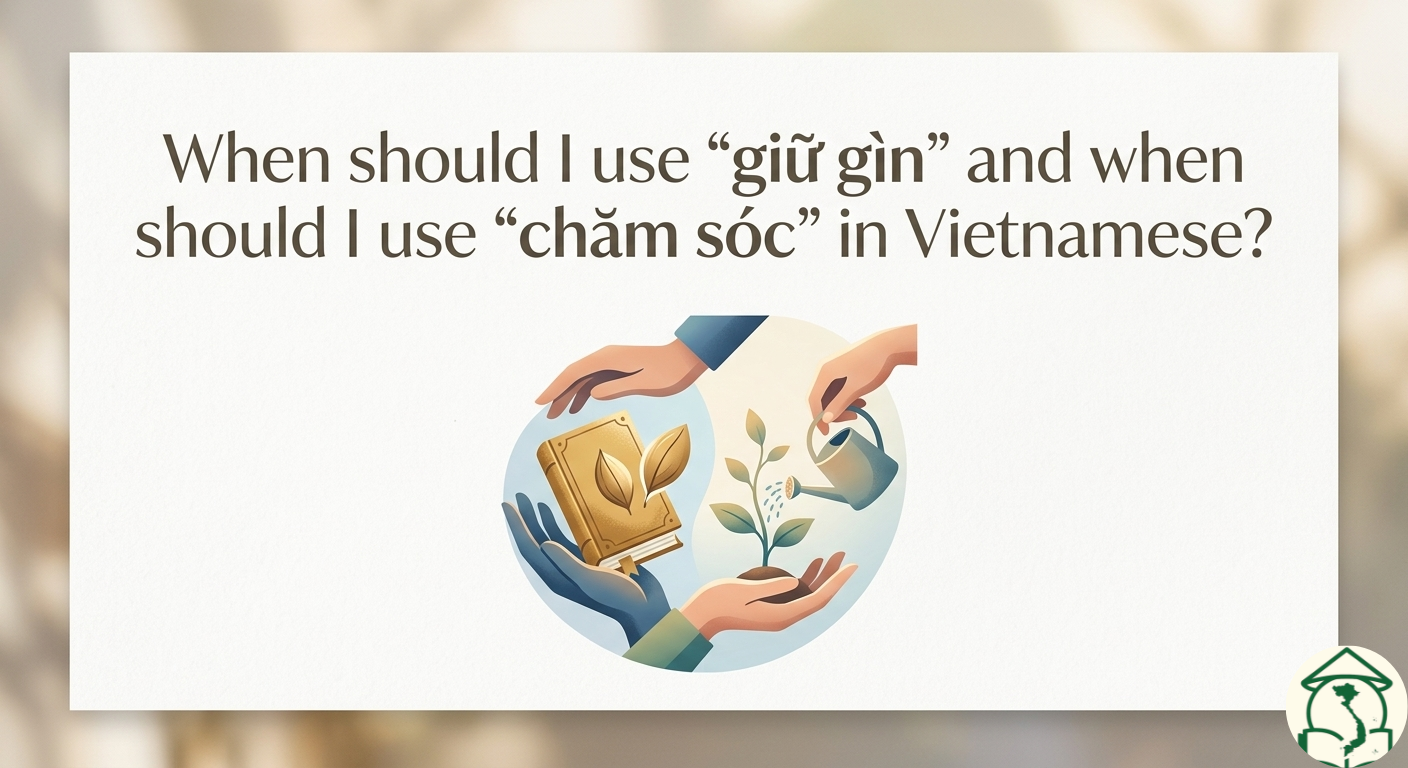
In Vietnamese, “giữ gìn” and “chăm sóc” are both related to taking care of something, but they focus on different intentions.
“Giữ gìn” means to preserve, maintain, or protect something so it stays in good condition. It often refers to keeping something safe, clean, or unchanged over time. It is commonly used for culture, health, environment, traditions, or personal belongings.
“Chăm sóc” means to actively look after someone or something by giving attention, help, or treatment. It usually involves actions and effort, especially when someone or something needs care. This word is often used for people, animals, plants, or health.
In simple terms:
Giữ gìn = protect or preserve
Chăm sóc = actively take care of
1/ Tôi luôn giữ gìn sức khỏe của mình. - I always preserve/take care of my health.
2/ Chúng ta cần giữ gìn môi trường sạch đẹp. - We need to preserve a clean environment.
3/ Cô ấy đang chăm sóc em bé. - She is taking care of the baby.
4/ Anh ấy chăm sóc cây mỗi ngày. - He takes care of the plants every day.
Use “giữ gìn” when the goal is protection or preservation.
Use “chăm sóc” when you mean actively looking after someone or something.
“Chăm sóc” often implies daily actions, while “giữ gìn” focuses on maintaining something in good condition.
A quick tip: You usually “chăm sóc” people and living things, but you often “giữ gìn” health, culture, and the environment.
6 Tones
Vietnamese has 6 distinct tones — each changes the meaning completely.
Latin Script
Unlike Chinese, Vietnamese uses the Latin alphabet with diacritics.
Pronouns
Use "anh/chị/em" instead of "bạn" — it shows respect and closeness.